Nora Lester Murad - The View From My Window in Palestine

  • About Me
    • Bio
    • Contact Me
    • Sign up for updates
  • My Writing
    • Life Under Occupation
    • Video/Radio
    • Guest Posts
    • Aid and Development
    • Gaza!
    • Palestinian Literary Scene
  • My Books
    • Resisting Erasure
    • Ida in the Middle
    • Rest in My Shade
    • I Found Myself in Palestine
  • Shop
  • Email
  • Instagram
  • LinkedIn
  • Twitter
  • YouTube

The Aroma of Tear Gas in the Air…

April 18, 2012 by Nora Lester Murad

Now that I have a car, I am often lazy and drive to Ramallah on the days I have business there. It’s best to go early and beat the intense traffic that is inevitable when a population expands and expands over decades but the roads are allowed to decay.

Recently, I drove into Qalandia checkpoint around 7:25 am and my eyes started stinging immediately. Damn tear gas. Not a nice way to start a day. Later I found out that a Palestinian boy had been killed the night before, martyred as they say locally, and the smell of tear gas was remnant from the battle that took his life. Not a battle, really. Palestinian boys with rocks against Israeli boys with guns. More of a set up than a battle.

I shouldn’t drink coffee even on good days. I should definitely not drink coffee on top of tear gas. It was a long, shaky day.

On the way home, there were still tires burning along the side of the main road down to Qalandia. I veered left to take Jeba’a Road (also called death way) and had to swerve around various burning items. That’s not all that unusual, but the smell of fresh tear gas was disconcerting. From a car, you can’t see what’s going on around you. You might unknowingly drive right into danger. I cracked the window and tried to hear.

My friend sat in the front seat next to me and commented casually about the shooting in front of us. I squinted into the dusk and saw long arcs of tear gas shot from the military vehicles up ahead on our left into the community of Ram on our right. I pulled to the side to confer with my friend. “Straight ahead or turn around?” Some cars were driving forward under the tear gas and others were turning around.

“They’re shooting into the air,” she said. “It’s only tear gas. It’s not like we’re going to get shot.” I took that as advice that I should press forward. I, too, wanted to go home, not get stuck on the short stretch of road between two hot spots. I drove fast.

We got to the roundabout near the Israeli settlement and seamlessly resumed our previous conversation about the community’s role in monitoring development projects. The gas was behind us. There was nothing more to say about it.

I got home and washed my clothes separate from our other clothes. I showered and washed my hair three times. My daughter said I smelled good, but my eyes still sting hours later.

Altogether, not an atypical day in Palestine.
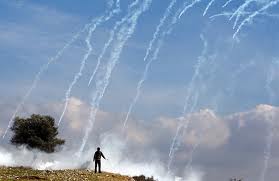
 

This is like what I saw, but I didn't take this photo.

My Mother-in-law’s Shaywa’ar

April 16, 2012 by Nora Lester Murad

“Open the door for me, Im Yaseen,” my mother-in-law says to me. I don’t have a son, but if I did, he would be named Yaseen after my father-in-law. The other daughters-in-law who do not yet have sons are also called “Im Yaseen. It’s like a placeholder for a future identity.

I hold open the screen door so she can get through with a huge metal tray piled with freshly-picked herbs. She balances it expertly on the wall of the front porch in a patch of sun so they can continue to dry.

“I like shaywa’ar more than I like maramiya,” I say reaching deep into the soft pile and inhaling deeply.

“I like maramiya better,” she says. But then, as if not to disappoint me, she adds, “and I like shaywar, too.”

“They aren’t familiar with this herb in Jerusalem. Did you know that?” The things I know better than my mother-in-law are limited to two categories: books (she is illiterate), and the world outside the Galilee (in her 73 years, she has barely traveled).

“Pick out the yellow leaves,” my mother-in-law directs me. And she goes to the backyard to bring another tray of shaywa’ar.

I pick out the yellow leaves and get hypnotized by the sweet, rich smell and the appearance of the delicate, curled leaves bursting from the little twigs. I think about the shaywa’ar I have at home in an old, plastic yogurt container that my mother-in-law gave me last time she dried a batch. I think about those little twigs and how they irritate me floating on the surface of my tea, making it hard to sip without spilling on myself. I decide, out of love for my mother-in-law, to do what she doesn’t have time to do herself—make this batch of shaywa’ar the cleanest batch ever.

I push the big pile of green-gray herbs to the far side of the tray and pull a fist -sized amount toward me. I pick up each twig. When the twigs are dry, the leaves fall right off; when the twigs are still moist with recent life, I have to pull each individual leaf to get it to release. I move the leaves to one side and make a stack of little twigs on the wall.

My mother-in-law sits next to me for a minute. Then she stands up and brings a plastic dish from the kitchen. She puts my little twigs into the plastic dish.

“Did you pick this shaywa’ar wild from the mountain?” I ask.

“No, we cultivated it in our fields.”

“From seeds?”

“From cuttings that we picked in the wild.”

“Does it grow out of control like mint?”

“No,” she answers. “Not like mint.”

And meanwhile, I am focused on cleaning every single twig of its leaves. On impressing my mother-in-law by cleaning her shaywa’ar better than it has ever been cleaned before. On building up my stack of twigs.

A young woman married to my husband’s cousin across the alley comes by for a minute and helps pick through shaywa’ar. Then she leaves. Then my husband’s uncle’s second wife comes by and pulls up a stool and starts picking at the tray. My mother-in-law stands over me although there is a chair for her to sit in.

“Hajji,” my husband’s uncle’s second wife asks my mother-in-law. “Why are you picking out those little twigs?” She gestures towards the plastic plate piled with tiny, naked twigs all lying neatly in the same direction.

“Im Yaseen did that,” she smiles at me politely.

“But they are flavorful,” my husband’s uncle’s second wife says to my mother-in-law, completely ignoring me. “Why do you waste them?”

“Oh!” I snap out of my shaywa’ar-induced trance. “Why didn’t you tell me I was doing it wrong, Hajji?”

“I told you to pick out the yellow leaves,” my mother-in-law says matter-of-factly. And she dumps the stack of neatly piled twigs in the center of the tray of leaves.

I’m not hurt. No one loves me more than my mother-in-law. But I’m a bit embarrassed. After twenty-five years in the family, I can’t do even the simplest of tasks correctly.

I lean back on the heavy plastic chair and let my hands, lightly powdered with nature’s dirt, rest in my lap. I look at the pile of twigs on top of the pile of leaves and identify with them – belonging but separate, giving flavor, but looking out of place.

Authentic Shaywa'ar from the Galilee

Can Palestinian Kids Hang Out at the Mall in Israel Safely?

April 10, 2012 by Nora Lester Murad

I know I have to write about what happened in Malha mall, but where can I find the words? Right in front of Aldo shoes, near the H&M where my daughters hold blouses up and ask, “How does this look on me?” and steps away from Lalushka where they buy pointe shoes and leotards – there was a mob riot. Sports fans from the nearby stadium streamed in shouting. They worked themselves into a frenzy chanting “Death to Arabs.” According to the reports, they attacked three Palestinian women with children eating in the food court!

Bad things happen every day here. Every single day someone is kidnapped from his bed in the middle of the night by Israeli soldiers, devastating his wife and children who look on helplessly. Every single day soldiers fire on peaceful protesters, sometimes knocking an eye out, or worse. Every single day soldiers stop young men in the street and frisk them against a wall, shaming them in front of neighbors and making them late for work. And of course there is “nonviolent” violence like revoking people’s residency rights, arbitrarily closing cultural institutions, and the like. It’s sad and scary and infuriating and unacceptable.

But the riot at Malha mall crossed a line. It erased a line! It’s a line that Israel tries to maintain to delude us into thinking that if we behave, everything will be fine, and that only “bad” people are at risk. No! Racism is an attack on all human beings.

PLEASE watch the video of the riot and read the short story and click on the links at this post of Electronic Intifada: http://electronicintifada.net/blogs/ali-abunimah/video-emerges-israeli-mob-shouting-death-arabs-attacked-palestinians-jerusalem#comment-4006. Watch it from beginning to end. Keep watching when it’s upsetting, and when you think it couldn’t possibly go on. Keep watching.

Imagine that this happened at the mall where your kids hang out, or on the bus that your kids take to school, or at a restaurant that you frequent as a family. Imagine the hatred was aimed at you. Imagine that mall security didn’t intervene. Imagine that your local police decided not to arrest anyone. Would you feel safe?

The view from my window in Palestine

March 30, 2012 by Nora Lester Murad

The view from my bedroom window isn’t very pleasing to the eye. That’s because the glass is so dirty. A “good” Palestinian woman spends a significant amount of time attacking the dust and dirt that permeates this place. She throws water on the floor and uses a squeegee to sweep it into drains built into the corner of each room for that purpose. I am a woman, but I am neither “good” nor Palestinian, so, if you visit my house, it is recommended to keep your shoes on.

The window in the living room is cleaner because we have an electric “treese” that we lower when it rains. (I’m sorry but I don’t know how to say “treese” in English and some people here call them “abujur.”) The treese is a slatted shade that comes down on the outside of windows. It is supposed to keep cold and rain out, but in our house rain comes not through the window, but right through the walls. It forms a not-so-small puddle on the floor where my youngest daughter works in her play laboratory.

Man next door throws snowballs onto neighborhood kids below during recent, rare snow

Talking about humidity… these are the patches of mold that seep through the outer walls in the winter. We wipe them off and they come back after a few days.

Mold growing on walls in my daughter

Why am I telling you this? Well if you’re interested in my life in Palestine, then you need to know about the inconveniences of living in a place where buildings are made poorly (most likely to keep costs down, but the risk of demolition may also be a factor). We also have power outages. And you know you have a problem with water pressure when your 12-year old says, “Mom, can we go to a hotel to have a shower?”

These are problems that the Israeli settlements just ¼ mile from my house do not face. Their infrastructure is updated and maintained, though we both pay the same taxes to the same Jerusalem municipality.

Why do I stay? (My mother keeps asking me that question, too.)

I could move back to my native California or my adopted Massachusetts. But I would miss the storeowner across the street from my apartment who yells at children for dawdling too long as they decide what candy to buy. I would miss Saeeda’s face lighting up as she tells me how women stood up to their husbands in defense of their community projects. I would miss watching my children switch effortlessly from English to Arabic including all the mannerisms and behavior that go with each. I would miss my car, as old and dented and red as I am. And I would miss my mother-in-law. And she would miss me!

I love my poor, old car!

So the view from my window in Palestine—dirty, moldy, and inconvenient (not to mention unjust, inhuman and depressing)—is also one of amazing people living important lives. “The view from my window in Palestine” is my point of view. If you’re interested, I’m happy to share it with you.

-Nora

  • « Previous Page
  • 1
  • …
  • 53
  • 54
  • 55
  • 56
  • 57
  • …
  • 61
  • Next Page »

Recent Posts

  • Media Coverage of My Lawsuit with Jenan Matari against the Los Angeles Public Library (running list)
  • Children’s Picture Book Review: “Never Again for Anyone”
  • Members of Educators Union Say Its Capitulation to ADL Betrays Workers, Students
  • On Teach Truth Day of Action: The Movement to #TeachTruth Includes Palestine, Too
  • How do we get the ADL out of schools? A conversation with Nora Lester Murad of #DropTheADLfromSchools.

Tweets!

Could not authenticate you.
  • Contact Me
  • About Me
  • Archive
  • Sign up for updates

Copyright © 2026, All rights reserved
Website Maintained by AtefDesign